
A distribution company can make a sale and still struggle to explain what happened between the customer order and the collected payment. Sales may promise stock that purchasing has not received. Warehouse teams may work from separate item lists. Delivery status may sit in messages, while finance waits to know when an invoice should be issued or followed up.
The purpose of ERP is not simply to replace each spreadsheet with a screen. It is to create one controlled transaction path in which the purchase, stock movement, sales order, delivery, invoice, return and receipt refer to the same products, customers, warehouses and approvals. This guide explains the workflow a Saudi distributor should examine before selecting or implementing a system.
- Sales cannot see dependable available stock by warehouse.
- The same item has different codes, units or descriptions across departments.
- Purchase orders do not reflect demand, reorder rules or current commitments.
- Picking and delivery changes are reported through calls or messages.
- Returns adjust customer balances but not the correct stock records—or the reverse.
- Management receives margin, ageing and collection reports only after manual consolidation.
Begin with clean product, customer and warehouse master data
Every later transaction depends on the master records created at the start. Define one item code, a controlled description, the base unit, permitted purchase and sales units, tax treatment, category and any barcode used. If the business handles batches, serial numbers, expiry dates or regulated products, document those requirements before configuration and confirm that the selected solution supports them.
Customer records should identify the legal and commercial information needed for quotations, orders, credit decisions, delivery and invoicing. Supplier records should support approved purchasing, payment terms and reconciliation. Warehouse and bin structures should reflect how goods are actually received, stored, picked, transferred and counted—not an idealised diagram that operations will not use.
Before importing old data, remove duplicates and agree who can create or change master records. A short approval step at this point prevents months of reporting problems later.
Connect procurement to demand and stock visibility
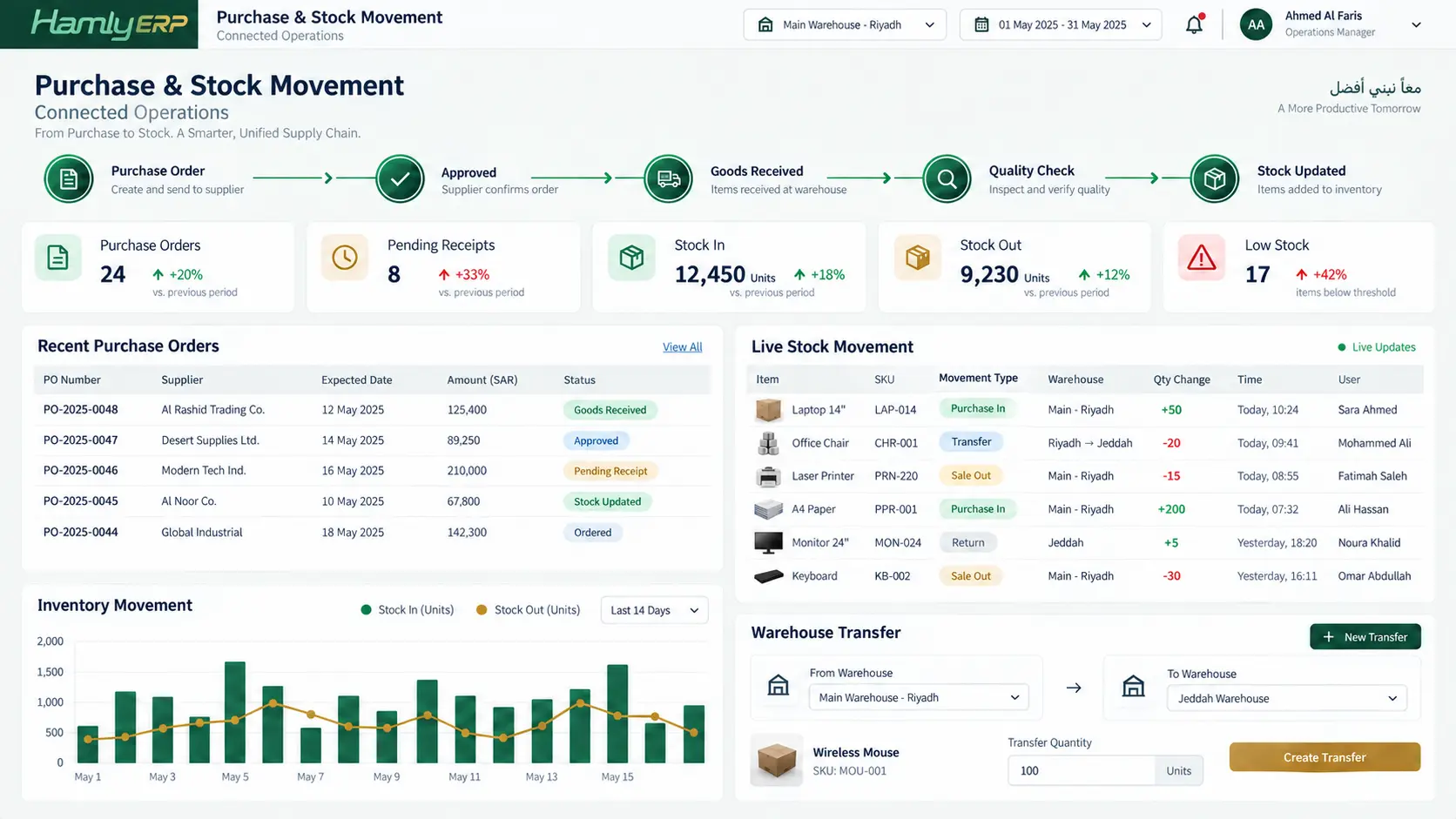
A useful purchasing workflow starts before the purchase order. The team should be able to examine current stock, reserved quantities, open customer demand, expected receipts and approved reorder rules. The objective is not to automate every decision immediately; it is to make the basis of the decision visible and reviewable.
- Purchase request: record the item, quantity, required date, warehouse and business reason.
- Approval and sourcing: apply the correct approval level and compare the agreed supplier terms.
- Purchase order: preserve the approved quantity, price, tax treatment and delivery location.
- Receiving: record actual quantities, shortages, damage and any required quality checks.
- Supplier invoice matching: compare the invoice with the order and receipt before posting or payment.
Hamly ERP's purchasing and inventory modules can be reviewed together in a demo so the proposed process is tested against the distributor's real documents and approval rules.
Separate physical stock from available-to-promise stock
“On hand” does not always mean “available.” Stock may already be reserved for confirmed orders, held for inspection, damaged, in transit or committed to another branch. A distributor should define which statuses affect sales availability and who can override a reservation.
Warehouse transfers should have a clear source, destination, dispatch confirmation and receipt confirmation. Adjustments should require a reason and authorisation. Cycle counts and full counts should produce a reviewable variance record instead of silently replacing the system quantity. These controls help management distinguish genuine demand from errors caused by delayed entries.
Build a controlled order-to-delivery workflow
The sales process should begin with a quotation or order linked to an approved customer and price. The system should show the relevant warehouse, available quantity, promised date, payment terms and credit status before confirmation. Special prices and discounts need an approval trail when they fall outside the agreed policy.
Once approved, the order can move through reservation, picking, packing, dispatch and proof of delivery. The exact stages depend on the operation. Some distributors invoice at dispatch, others after confirmed delivery, and some use partial deliveries. The implementation must define these events clearly so stock, revenue, VAT records and customer balances are not updated at inconsistent times.
Returns require the same discipline. Record the original sale, reason, product condition, warehouse destination and commercial outcome. A return may go back to saleable stock, quarantine, supplier return or write-off. Credit notes, replacements and refunds should follow authorised rules and remain linked to the original transaction.
Keep Saudi invoicing requirements inside the process
Saudi e-invoicing should be treated as part of the sales and accounting workflow, not as a separate document created after the transaction. ZATCA explains that Phase Two is introduced in waves and requires targeted taxpayers' electronic solutions to integrate with ZATCA systems and generate invoices in the required format. Businesses should confirm their own notification, invoice types, technical scope and current requirements directly with ZATCA and qualified advisers.
Review Hamly ERP's ZATCA e-invoicing workflow using representative B2B, B2C, return and credit-note scenarios before production use. For official information, consult ZATCA's e-invoicing introduction and roll-out phases.
Connect invoicing, accounting and collection
When delivery and invoicing are connected, finance can follow customer balances without waiting for a spreadsheet from sales. Each invoice should carry the correct customer, terms, due date and related delivery. Receipts should be allocated to the right invoices, while deductions, disputes and credit notes remain visible.
Management should review gross margin by product and customer, overdue receivables, blocked orders, stock ageing, inventory turnover, fulfilment performance and return reasons. These measures are useful only when source transactions are timely and consistently classified. Dashboards cannot repair weak master data or missing warehouse entries.
Implement one route before scaling
A safer rollout uses a limited but complete pilot: one branch or warehouse, a controlled item group, selected customers and one order-to-collection route. Test normal orders, partial delivery, transfer, return, damaged stock, credit limit, credit note and payment allocation. Reconcile stock and customer balances against approved control totals.
- Can the team maintain one item master with the required units and controls?
- Can sales see meaningful available stock and expected receipts?
- Are purchasing, receiving and supplier invoices linked?
- Do transfers, counts and adjustments preserve an approval history?
- Can partial delivery, returns, credit notes and replacement flows be tested?
- Can finance reconcile inventory, sales, VAT, receivables and receipts?
- Are Arabic and English documents, roles and reports suitable for the users?
- Are migration, integrations, support and customisation defined in writing?
For multi-branch retail operations, also read our guide to connecting POS and inventory across Saudi branches.
Review your real distribution workflow with Hamly ERP
Bring a sample purchase order, receiving note, sales order, delivery document, return, invoice and collection report. The Hamly ERP team can map the required steps, identify configuration and integration questions, and prepare a focused demonstration. Feature availability, ZATCA integration, customisation, migration and support must be confirmed in the written implementation scope.
Book a distribution ERP demonstration →
Frequently asked questions
What does ERP software do for a distribution company?
It can connect product and customer data with purchasing, warehouse movements, sales orders, delivery, returns, invoicing, accounting and collection. Confirm the exact workflow supported by the selected solution.
Which distribution workflow should be implemented first?
Start with one measurable route such as purchase order to receiving, or sales order to delivery and collection. Define owners, approvals, master data and reports before expanding.
How should stock be managed across several warehouses?
Use one controlled item master, documented locations, authorised transfers and clear rules for receiving, reservation, picking, returns and adjustments.
Does ERP automatically make Saudi e-invoices compliant?
No. Configuration, onboarding, integration and testing must follow the business's applicable requirements and current official guidance.
Can a distributor migrate from spreadsheets?
Yes, subject to data quality and scope. Clean item codes, units, opening stock, balances, price lists and tax settings before testing imports and reconciling totals.